Best Home Standby Generators

A home standby generator is one of those purchases you hope you’ll never need — until the power goes out at 2 a.m. in January and you’re very glad you have one. Unlike portable generators that you have to drag out of the garage and start manually, standby units are permanently installed in your yard and kick on automatically within seconds of a power failure. They run on your existing natural gas or propane supply, so there’s no scrambling for gasoline in the middle of a storm.
The market is dominated by a handful of brands, with Generac leading the pack as the number-one selling standby generator brand in the U.S. Below, we’ll compare the best home standby generators available on Amazon, break down how much power you actually need, and cover what to expect for installation — including what the generator means for your yard and landscaping.
How Much Power Do You Need?
Before comparing specific models, you need to figure out what size generator your home requires. Getting this right is critical — too small and the generator can’t keep up during a full outage, too large and you’ve overspent by thousands of dollars.
Quick sizing guide:
10kW (10,000 watts) — Covers essential circuits only: refrigerator, sump pump, well pump, a few lights, phone chargers, and your Wi-Fi router. This is the entry-level choice for smaller homes or homeowners who only want to keep the basics running. It will not power your central air conditioning or electric range.
14kW to 18kW — The sweet spot for most homes. A 14kW unit handles essential circuits plus a few comfort items like a window AC unit or microwave. An 18kW unit can manage a small central air conditioning system (up to about 3 tons) along with the essentials. These sizes fit the majority of homes under 2,500 square feet.
22kW to 26kW — Whole-house coverage for mid-size to large homes. A 22kW generator can power a 3- to 4-ton central AC system, electric water heater, kitchen appliances, and most of your home’s circuits simultaneously. The 24kW and 26kW models are for larger homes with higher electrical demands — multiple AC zones, electric ranges, hot tubs, or large workshops.
A note on fuel type: Most home standby generators run on either natural gas or liquid propane (LP). If your home has a natural gas line, that’s the most convenient option — unlimited fuel supply, no tank to refill. If you’re on propane, you’ll need a tank large enough to run the generator for extended outages. A 500-gallon tank is a common minimum for standby generator use. Keep in mind that generators produce slightly less power on natural gas than on propane, so check the specs for both fuel ratings.
Best Generac Home Standby Generators
Generac dominates the home standby market, and for good reason. Their Guardian Series offers a complete lineup from 10kW to 26kW, all engineered and assembled in the U.S.A. Every current Guardian model includes WiFi connectivity through Generac’s Mobile Link system, which lets you monitor your generator’s status, receive maintenance alerts, and check run history from your phone.
All Guardian Series generators feature Generac’s True Power Technology, which delivers clean, stable electricity with less than 5% total harmonic distortion — safe for sensitive electronics like computers and smart home systems. They also include a Quiet-Test self-test mode that runs at lower RPM, keeping the weekly exercise cycle quieter than the competition.
Generac Guardian 10kW

Best for: Essential circuit coverage in small homes
The entry point into the Guardian lineup. The 10kW model powers your most critical systems — refrigerator, sump pump, well pump, furnace, lights, and a handful of outlets. It pairs with a 100-amp automatic transfer switch that covers up to 16 essential circuits.
At roughly 48 x 25 x 29 inches, it has the smallest footprint in the lineup, making it the easiest to tuck into a side yard or conceal with landscaping. The compact size also means less visual impact on your yard.
Key specs: 10,000 watts (LP) / 9,000 watts (NG) · 100-amp transfer switch · WiFi enabled · 5-year limited warranty
Generac Guardian 14kW
 Best for: Essential circuits plus comfort items in small to mid-size homes
The 14kW model steps up from essentials into comfort territory. It can handle everything the 10kW covers plus a window AC unit, microwave, dishwasher, and additional lighting circuits. Available with either a 100-amp (16-circuit) or 200-amp (whole house) transfer switch — the 200-amp version is worth the upgrade if your electrical panel supports it, as it eliminates the need to choose which circuits to back up.
Key specs: 14,000 watts (LP) / 14,000 watts (NG) · 100A or 200A transfer switch options · WiFi enabled · 5-year limited warranty
Generac Guardian 18kW
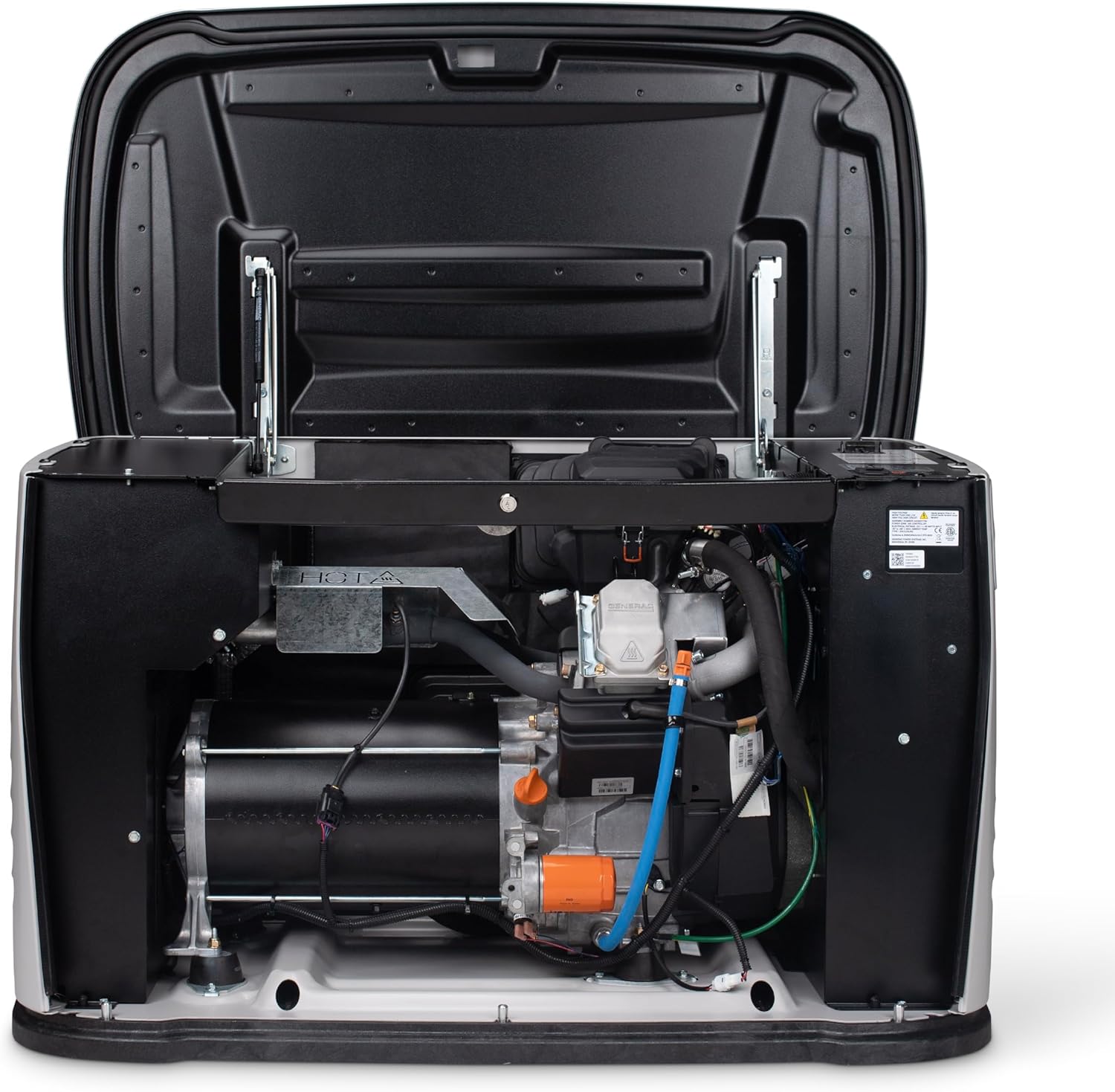
Best for: Most mid-size homes with central air conditioning
This is where whole-house backup becomes realistic for the average American home. The 18kW model can run a small central AC system (2 to 3 tons), electric water heater, kitchen appliances, and your full lighting package simultaneously. For homes under 2,500 square feet with a gas furnace and 2- to 3-ton AC, this is often the right-size choice.
Key specs: 18,000 watts (LP) / 18,000 watts (NG) · 200-amp transfer switch · WiFi enabled · 5-year limited warranty
Generac Guardian 22kW

Best for: True whole-house coverage for mid-size to large homes
The national best-seller. The 22kW Guardian is the most popular home standby generator in the country, and it’s the model most installers recommend for homes between 2,000 and 4,000 square feet. It powers a 3- to 4-ton central AC system, all kitchen appliances including an electric range, laundry equipment, and every circuit in most homes.
If you’re unsure what size to get and your home is a typical 3-bedroom with central air, this is the safe choice.
Key specs: 22,000 watts (LP) / 19,500 watts (NG) · 200-amp transfer switch · WiFi enabled · 5-year limited warranty
Generac Guardian 24kW

Best for: Larger homes with higher electrical loads
The 24kW model is for homes that push the limits of the 22kW — larger AC systems (4 to 5 tons), electric vehicle chargers, workshops, or homes with multiple high-draw appliances running simultaneously. It comes standard with a 200-amp service-entrance-rated transfer switch.
Key specs: 24,000 watts (LP) / 21,000 watts (NG) · 200-amp SE-rated transfer switch · WiFi enabled · 5-year limited warranty
Generac Guardian 26kW

Best for: Large homes and maximum coverage
The flagship of the Guardian lineup. The 26kW model delivers the most power in Generac’s air-cooled residential range and is designed for homes over 4,000 square feet or those with exceptionally high electrical demands. It’s the right choice if you want true “everything on” capability during an outage — every circuit, every appliance, no compromises.
The 26kW is the largest unit in the lineup physically, so plan accordingly for your yard. It will require a bit more creative landscaping to conceal than the smaller models.
Key specs: 26,000 watts (LP) / 22,000 watts (NG) · 200-amp SE-rated transfer switch · WiFi enabled · 5-year limited warranty
Champion aXis 22kW Home Standby Generator
Best for: Homeowners who want Generac-level performance from an alternative brand
Champion is best known for their portable generators, but the aXis 22kW is their entry into the whole-house standby market — and it’s a strong one. It comes with a 200-amp whole-house automatic transfer switch and features Champion’s aXis intelligent load management, which prioritizes power delivery to your most critical circuits during high-demand periods.
One notable advantage: Champion’s customer support and warranty service have a strong reputation among homeowners. The aXis comes with a 10-year limited warranty on specific components, which is more generous than Generac’s standard 5-year coverage.
Key specs: 22,000 watts (LP) / 19,500 watts (NG) · 200-amp transfer switch · WiFi enabled · 10-year limited warranty (varies by component)
Westinghouse Tri-Fuel Portable Generators
Best for: Budget-conscious homeowners, renters, or those who want portability
If a permanently installed standby generator isn’t in the budget (they typically run $3,000 to $7,000+ before installation), Westinghouse’s tri-fuel portable generators offer serious backup power at a fraction of the cost. Their 12,500W to 28,000W models run on gasoline, propane, or natural gas — giving you maximum fuel flexibility during emergencies.
The trade-off: portable generators require manual setup during an outage, they’re louder than standby units, and they can’t legally be permanently wired into your home’s electrical panel without a transfer switch. But for many homeowners, a high-wattage portable paired with a manual transfer switch is a practical and affordable backup power solution.
Since portable generators are stored in a garage or shed and only set up outdoors during use, they don’t require the permanent landscaping considerations of standby units. However, you should still have a designated spot in your yard — a gravel pad or concrete slab at least 20 feet from the house — ready to go before storm season.
Key specs (28,000W model): 28,000 peak watts / 20,000 running watts · Tri-fuel (gas/propane/NG) · Remote electric start · Transfer switch ready · CO sensor
What to Expect for Installation
Buying the generator is only part of the equation. Installation is a significant project that involves electrical work, gas line connections, and concrete pad preparation.
Typical installation costs: $3,000 to $6,000 on top of the generator purchase price, depending on your area, the complexity of the electrical work, and how far the generator sits from your electrical panel and gas meter.
What’s involved:
— Pouring or placing a concrete generator pad (or preparing a compacted gravel bed)
— Running a gas line from your meter or propane tank to the generator
— Installing the automatic transfer switch at your main electrical panel
— Running electrical conduit from the transfer switch to the generator
— Obtaining permits and passing inspection (required in virtually all jurisdictions)
— Final testing and activation
Impact on your yard: Installation typically requires trenching for the gas line and electrical conduit, which means a strip of your lawn will be dug up. The good news is that trenches are usually only 12 to 18 inches wide and can be reseeded or sodded within a few weeks. If you’re planning to reseed the disturbed area, fall is the ideal time for cool-season grasses.
Placement considerations: Work with your installer to position the generator where it balances code requirements (at least 18 inches from the house, 5 feet from windows and doors, 5 feet from property lines) with your landscaping plans. Placing the unit close to both the electrical panel and gas meter reduces installation costs — but placing it on the side of the house least visible from the street makes your landscaping and curb appeal job much easier.
Maintenance and Your Lawn
Home standby generators run a brief self-test cycle weekly (typically 10 to 20 minutes) to keep the engine lubricated and verify everything works. This is normal and shouldn’t concern your neighbors — modern units run their test cycle at reduced RPM and are about as loud as a central AC condenser.
Annual professional maintenance is recommended and typically includes an oil and filter change, spark plug inspection, battery check, and a full load test. Make sure your landscaping allows clear access for the technician — a stepping-stone path from the nearest walkway to the generator is a practical and attractive solution.
Over time, generator exhaust can brown the grass immediately around the unit. If this is an issue, replacing the turf in the exhaust zone with gravel or decorative stone eliminates the problem permanently. For the surrounding lawn, regular fertilization and proper watering will keep everything looking healthy right up to the edge of your generator zone.
Which Generator Should You Buy?
For most homeowners, the decision comes down to how much of the house you want to power:
Just the essentials (lights, fridge, sump pump, furnace): Generac Guardian 10kW or 14kW
Essentials plus AC (the most common setup): Generac Guardian 18kW or 22kW
Everything, no compromises: Generac Guardian 24kW or 26kW
Alternative brand with strong warranty: Champion aXis 22kW
Budget-friendly portable option: Westinghouse 28,000W tri-fuel
Whichever model you choose, factor in the cost and timeline for installation, make sure your yard can accommodate the unit within code clearances, and start planning your landscaping concealment strategy early — ideally before installation day, so the landscaping and generator work can be coordinated together.
This post contains affiliate links, which means Finest Lawns may earn a small commission if you purchase through our links — at no extra cost to you. We only recommend products we’d use in our own yards.